So. Go ahead and want. Want to gain release from suffering. Want to gain merit. Want to go to heaven. Want to go to nibbana. Go ahead and want as much as you like, because it's all part of the path. It's not the case that all wanting is craving (tanha). If we think that all wanting is craving, then if we don't let there be craving, it's as if we were dead. No wanting, no anything: Is that what it means not to have defilement or craving? Is that kind of person anything special? It's nothing special at all, because it's a dead person. They're all over the place. A person who isn't dead has to want this and that — just be careful that you don't go wanting in the wrong direction, that's all. If you want in the wrong direction, it's craving and defilement. If you want in the right direction, it's the path, so make sure you understand this.
-- Venerable Acariya Maha Boowa Ñanasampanno
27 April 2007
Go Ahead and Want


25 April 2007
Is Wicca a Religion?
One reason that the VA gave for refusing the Wiccan request for grave-site symbology, invoked the lacked of centralized authority within Wicca. That might have been part of the answer, but I suspect other factors played a part, factors centered on other aspects of Wiccan practice, aspects that many people refuse to see as being really "religious". On another blog (GetReligion), I posted further thoughts on the "centralized authority" excuse:
The “centralization” thing seems fishy to me. Who’s the central authority for Jews and Muslims? If the VA does have single organizations in mind that it believes represent all Jews or all Muslims, how do the other Jews and Muslims feel about that?
True, there is no “one” centralized authority for all Jews, or all Muslims, or all Christians. But there is The Episcopal Church, the Southern Baptist Convention, and so forth. Of course, there are Wiccan religious organizations, as well.Notice the former requirements for a religion in order for its emblem to be recognized by the VA:
1. A written request from the recognized head of the religious group,
2. A list of national officers, and
3. A membership tally.A religion like Wicca, even though it does possess some level of organizational structure, is not dependent upon such structure. It is commonly accepted among Wiccans that one can be a Wiccan without joining a coven, or without being initiated by a priestess or priest. In a nation broadly pervaded by Christianity, where Christianity serves as the model of what a real religion entails (community, belief, sacred text, particular ideas of divinity, etc.), Wicca can certainly appear not “really” a religion, as something people just “make up”. And, indeed, there is tremendous potential for Wiccan creativity in the construction of their Book of Shadows and magickal rituals. Within a Christian framework, that’s not “religion” — religion has a defined Deity (preferably masculine), a defined founder (preferably male), a defined doctrine (preferably written in sacred texts and conciliar documents); religion, moreover, does not involve nudity, or sex, or invoking spirits — things Wiccans have been known to include in their rituals.(By contrast, even Scientologists and Eckankarists are not known for engaging in such distinctive behavior!) From a historically Christian perspective held by many Christians, whether Protestant or Catholic, Wicca might be “spiritual”, but it’s not “religious”.
The definitions that the VA formerly used to define what counts as a religion, originated out of a Christian matrix. I’m not saying that’s ‘good’ or ‘bad’, just that in 21st-century America, governmental administrations have to be aware of the tendency to judge all religious and spiritual paths, in terms of how much they fit into traditionally Christian notions of organizational and ritual characteristics of what “religion” really is.
Without having read all 30,000 documents created by the VA, I would just have to strongly suspect that some of the VA decision-making process involved a conscious and unconscious comparison (and not just at the level of centralized organization, I agree!) of Wicca with Christianity and other formally recognized religions, with Wicca coming up with the short end of the stick.
Pentacle Power

April 23, 2007
The Wiccan pentacle has been added to the list of emblems allowed in national cemeteries and on government-issued headstones of fallen soldiers, according to a settlement announced Monday.
A settlement between the U.S. Department of Veterans Affairs and Wiccans adds the five-pointed star to the list of "emblems of belief" allowed on VA grave markers.
Eleven families nationwide are waiting for grave markers with the pentacle, said Selena Fox, a Wiccan high priestess with Circle Sanctuary in Barneveld, Wis., a plaintiff in the lawsuit.
After more than 10 years, Wiccans are now allowed to have the pentacle in national cemeteries and on government-issued headstones of Wiccan military. Now, you might ask yourself, "What took them so long?!" I'm glad you asked.
How do you define a religion? OK, not "you" personally, but the U. S. Department of Veterans Affairs? Until 2005, the VA included in its definition of "religion" the necessity of a central headquarters or centralized authority. Since Wiccans lack such a centralized authority, let alone a "headquarters", Wicca was not seen as a real, bona fide, religion. It might be spiritual, but a religion?? Nah! The following is from a Washington Post story from 2006:
The "central authority" requirement was lifted in 2005, so one might argue that that's why it took more than 10 years for the Wiccan request to go through. But even 2 years is apparently a long time by VA standards, so why the prolongation? Conspiracy theories abound, and I'm sure the political climate had something to do with it. Wiccans don't exactly have a pure reputation in America. Many people automatically (or after due consideration) lump Wiccans along with Satanists, demon-worships, dreaded polytheists, pertinacious pagans, and general undesirables. I need not go into why all that is incorrect on this blog. Suffice it to say that many persons see the existence of Wicca as an affront to their own religious tradition, and are (thus, understandably) not too keen on having Wicca recognized -- in any form whatsoever -- by the U. S. federal authorities. But freedom of religion for one, means freedom of religion for all. (See also this.)
Department spokeswoman Josephine Schuda said VA turned down Wiccans in the past because religious groups used to be required to list a headquarters or central authority, which Wicca does not have. But that requirement was eliminated last year, she noted.
There's another issue here, though: what counts as religion in First Amendment definition? Must it be organized with a central authority? Or does it merely have to involve belief in, and practice directed towards, what is super-natural? I'll leave that for another day.
20 April 2007
Wisdom and Love
I find that somehow, by shifting the focus of attention, I become the very thing I look at, and experience the kind of consciousness it has; I become the inner witness of the thing. I call this capacity of entering other focal points of consciousness, love; you may give it any name you like. Love says "I am everything". Wisdom says "I am nothing". Between the two, my life flows. Since at any point of time and space I can be both the subject and the object of experience, I express it by saying that I am both, and neither, and beyond both.
-- Nisargadatta Maharaj
18 April 2007
Awakening and Accomplishing
There is a path of awakening threading through all the traditions, from Vedanta to Zarathustric, from Judaic to Baha'i, from Orishic to shamanic, from Christic to humanist. This path of awakening is eternally free, unbound, and yet simultaneously embedded and embodied. Its happiness is its discipline. Its responsibility is its freedom.
The path of accomplishment threads through the entire cosmos. From Betelgeuse to Sol, from volcanic hot-springs to Icelandic glaciers, from the wetlands of the barrier islands to the snowy deserts of Inner Mongolia, from amoebic competition to the electro-magnetic domiciles of the bodily-naked ape, all things are done via accomplishment.
Awakening (Sanskrit budh, as in buddha) and Accomplishing (Sanskrit sidh, as in siddha) unite at the root. Awakening represents the Beloved; Accomplishing, the Jivanta. To manifest both creates a Buddha, a BuddhaSiddha.
The path of accomplishment threads through the entire cosmos. From Betelgeuse to Sol, from volcanic hot-springs to Icelandic glaciers, from the wetlands of the barrier islands to the snowy deserts of Inner Mongolia, from amoebic competition to the electro-magnetic domiciles of the bodily-naked ape, all things are done via accomplishment.
Awakening (Sanskrit budh, as in buddha) and Accomplishing (Sanskrit sidh, as in siddha) unite at the root. Awakening represents the Beloved; Accomplishing, the Jivanta. To manifest both creates a Buddha, a BuddhaSiddha.
17 April 2007
FM
Each saint, prophet, or avatar has his or her intimate beloved. In the Indic traditions, one name commonly describes both individuals. Instead of saying "Krishna and Radha", one would say "RadhaKrishna", with the feminine person preceding the masculine person.
In the Christian tradition, then, one proposes Mary-Jesus, or MiryamYeshu.
In the Christian tradition, then, one proposes Mary-Jesus, or MiryamYeshu.
Mary
Mary, Mother of Yeshu Christos, has the Hebrew form Miryam. In Sonic Theology, Miryam vibrates at different frequencies: mi means "to fasten to the earth"; r (as related to the Sanskrit "r.") links to "heaven"; and yam forms "to be firm". Miryam promises to establish Heaven on Earth.
16 April 2007
Y. C.

The Name "Yeshu Christos" may be pronounced like so: Yee (rhymes with, or r.w., "say") Shuu (r.w. "shoe") Krii (r.w. "sea") Stoos (r.w. "dose"). In Sonic Theology, "Yee" refers to the Sanskrit "yee" or "yei", meaning "one who"; "Shuu" refers to the root "shu", meaning "to grow, to increase"; and "Krii-Stos" links to "kristi", meaning "the human race".
Yeshu Christos is He who enriches the human race and, by extension, all beings.
Alpha and Omega
St. John's vision of the Revelation revealed a Yeshu Christos full of warning and promise, who proffered a claim that embraced it all:
What, precisely, is this "Alpha and Omega", this "beginning" and this "end"? The Indic Shivology of Shaiva Siddhanta may be of some help. Shaiva Siddhanta classifies all reality into 36 categories of existence, or 36 "tattvas", from beginning to end. The first 5 tattvas are purely Spiritual:
The next 7 tattvas are a mixture of Spiritual and Material:
The last 24 tattvas are purely Material:
Not delimited by any of these categories of existence is the "non-tattva", or "atattva":
Yeshu Christos, speaking from the position of Atattva, embraces all tattvas, from Shiva tattva to Prithivi tattva, from beginning to end, Alpha to Omega. Only He Who is aware of all tattvas, and thus non-identical to, yet non-separate from, the tattvas, can include the tattvas. Yeshu Christos is Shiva and Shakti; Creator-Brahma, Preserver-Vishnu, and Dissoluter-Rudra; desire, knowledge, and time; intellect, instinct, and the senses; all the elements, from ether, to air, fire, water, and earth; energy, atoms, molecules, life, plants, animals, man, and woman.
When the Name is spoken, everything is consumed.
"I am the Alpha and the Omega, the first and the last, the beginning and the end" (Revelation 22:13; New American Bible).
What, precisely, is this "Alpha and Omega", this "beginning" and this "end"? The Indic Shivology of Shaiva Siddhanta may be of some help. Shaiva Siddhanta classifies all reality into 36 categories of existence, or 36 "tattvas", from beginning to end. The first 5 tattvas are purely Spiritual:
1) Siva tattva: Parashakti-Nada (Satchidananda, pure consciousness)
2) Shakti tattva: Parameshvara-Bindu(Nataraja, Personal God), energy, light and love
3) Sadashiva tattva: the power of revealment (Sadashiva)
4) Ishvara tattva: the power of concealment (Maheshvara)
5) Shuddhavidya tattva: dharma, pure knowing, the powers of
dissolution (Rudra), preservation (Vishnu) and creation (Brahma)
The next 7 tattvas are a mixture of Spiritual and Material:
6) maya tattva: mirific energy
7) kala tattva: time
8) niyati tattva: karma
9) kala tattva: creativity, aptitude
10) vidya tattva: knowledge
11) raga tattva: attachment, desire
12) purusha tattva: the soul shrouded by the above five tattvas
The last 24 tattvas are purely Material:
13) prakriti tattva: primal nature
14) buddhi tattva: intellect
15) ahamkara tattva: external ego
16) manas tattva: instinctive mind
17) shrotra tattva: hearing (ears)
18) tvak tattva: touching (skin)
19) chakshu tattva: seeing (eyes)
20) rasana tattva: tasting (tongue)
21) ghrana tattva: smelling (nose)
22) vak tattva: speech (voice)
23) pani tattva: grasping (hands)
24) pada tattva: walking (feet)
25) payu tattva: excretion (anus)
26) upastha tattva: procreation (genitals)
27) shabdha tattva: sound
28) sparsha tattva: feel/palpation
29) rupa tattva: form
30) rasa tattva: taste
31) gandha tattva: odor
32) akasha tattva: ether
33) vayu tattva: air
34) tejas tattva: fire
35) apas tattva: water
36) prithivi tattva: earth
Not delimited by any of these categories of existence is the "non-tattva", or "atattva":
Atattva: Parasiva (Sivalinga, Absolute Reality), beyond all categories
Yeshu Christos, speaking from the position of Atattva, embraces all tattvas, from Shiva tattva to Prithivi tattva, from beginning to end, Alpha to Omega. Only He Who is aware of all tattvas, and thus non-identical to, yet non-separate from, the tattvas, can include the tattvas. Yeshu Christos is Shiva and Shakti; Creator-Brahma, Preserver-Vishnu, and Dissoluter-Rudra; desire, knowledge, and time; intellect, instinct, and the senses; all the elements, from ether, to air, fire, water, and earth; energy, atoms, molecules, life, plants, animals, man, and woman.
When the Name is spoken, everything is consumed.
15 April 2007
All Great Ones Had Their Teachers
All great ones had their teachers. All the sages, saints, prophets, world teachers, incarnations, great men have had their own Gurus, however great they might have been. Svetaketu learnt the nature of Truth from Uddalaka, Maitreyi from Yajnavalkya, Bhrigu from Varuna, Narada from Sanatkumara, Nachiketas from Yama, Indra from Prajapati; and several others humbly went to wise ones, observed strict Brahmacharya, practised rigorous discipline, and learnt Brahma-Vidya from them.
Lord Krishna sat at the feet of His Guru Sandipani. Lord Rama had Guru Vasishtha who gave Him Upadesa. Lord Jesus sought John to be baptised by him on the banks of the river Jordan. Even Devas have Brihaspati as their Guru. Even the greatest among the divine beings sat at the feet of Guru Dakshinamurti.
-- Swami Sivananda
14 April 2007
Yeshu Christos
Yogisvarah: The Lord of Yogis
Ekameva: God and Only God
Shiva: The Bearer of Good News
Utthana: The Resurrection
Chit: Pure Awareness
Rukmavat: He Who Wears Gold
Ishta-Devata: The Attractive One
Senanih: The Lord of Hosts
Tarakarih: The Vanquisher of Tyrants
Ojas: The Water of Life
Shankarah: The Prince of Peace
In Sonic Theology, the Aramaic-Greek name "Yeshu Christos" (or "Jesus Christ") contains a set of initial letters sonically linked to Sanskritic terms of Divinity, Transcendence, and Spirituality. Embedded within this name, then, exists a summary of the Indic Revelations.
Ekameva: God and Only God
Shiva: The Bearer of Good News
Utthana: The Resurrection
Chit: Pure Awareness
Rukmavat: He Who Wears Gold
Ishta-Devata: The Attractive One
Senanih: The Lord of Hosts
Tarakarih: The Vanquisher of Tyrants
Ojas: The Water of Life
Shankarah: The Prince of Peace
In Sonic Theology, the Aramaic-Greek name "Yeshu Christos" (or "Jesus Christ") contains a set of initial letters sonically linked to Sanskritic terms of Divinity, Transcendence, and Spirituality. Embedded within this name, then, exists a summary of the Indic Revelations.
03 April 2007
Take Up and Read!

I was saying these things and weeping in the most bitter contrition of my heart, when, lo, I heard the voice as of a boy or girl, I know not which, coming from a neighbouring house, chanting, and oft repeating, "Take up and read; take up and read."
-- St. Augustine
The Beloved has produced two books for us to read: the Book of Nature, and the Book of God. The Book of Nature is the Beloved's Creation, Light, Atoms, Molecules, Life, Plants, Animals, and Men and Women. The Book of God is the Buddha, the Christ, and silent, unwritten, and written words thereof, such as the Bible, the Qur'an, and the Vedas.
The Book of Nature is the Jivanta.
The Book of God is the Buddha.
The Guru is not just the Buddha, the Christ, but also the Jivanta, the Creation.
Read any Book, and that Book will take you to the Beloved.
02 April 2007
Fr. Hopko on Dialogue
CC.com: Yesterday you said Orthodoxy was not just one denomination among many. What is the dialogue with evangelicals trying to accomplish, or how do you make that point to evangelicals who do see Orthodoxy as one of many denominations?
Fr. Hopko: I deal with that issue in Speaking the Truth in Love also, because dialogical is the way that it's done. You encounter, you speak, you have to listen in order to relate, so there's always a missionary dimension to dialogue. But it's also a dimension of testimony, it's also a willingness to have yourself tested. Okay, you think that we're wrong -- say why. Let's talk about it.
If we're all Christians, we all love Jesus, we all want the truth, and we don't agree about what that is, we'd better talk about it, and try to have enough dialogue so that we know what we actually disagree about! John Courtney Murray once said, "We don't know enough about each other even to disagree accurately." We've been separated from the Latin West for 900 years!
However, there are all these dangers. The danger could be exactly toward denominationalism. Even at Trinity Western the other night, when an evangelical who doesn't have a concept of the historical church and the sacramental church says, "I agree with everything you said," sometimes I'm tempted to say, "No you don't!" Because if you're inventing worship every week, and you don't believe that there's a church in history or that it all started in reality in the 16th century, you don't believe what we believe!
Now, the fact that we quote the Bible and talk about how Jesus saves us, you might relate to and believe in it, but the minute you come to how you access it, how it becomes yours, how you live it out -- I still think that there are incredible differences between evangelicals and Eastern Orthodox. Because for us, the Church is part of the gospel. Let me put it this way: The gospel implies the Church.
Fr. Florovsky used to talk about ecumenism in time, as well as in space. Who are you with in the past? You name any century, and we'll tell you who our guys were, and we'll tell you where we think the Church was, and we'll tell you where we think it wasn't, at least not in its fullness, where it became defective. In the early Church, we're with the so-called Catholics and not with the Gnostics and the Montanists. After the 4th century, we're with Athanasius, Basil, Gregory and the Nicene communities. In the 5th century, we're with the Chalcedonian communities, and in the later centuries, we're with Photius as against the papacy.
We have a history that we deeply identify with. We speak about Gregory and Basil as if they were our contemporaries, because mystically they are -- they are! And that's one thing that I think evangelicals, at least in their organic traditions, don't relate to.
In fact, a lot of times, as a matter of fact, they don't even know about it. They don't have the foggiest idea who these people even are. I've met United Church of Canada people who didn't know what the Nicene Creed was, and they were at a [World Council of Churches] Faith and Order Commission meeting representing their church! Seriously.
Then they say, "Why do you need it, it's Greek philosophy, it's old-fashioned, no modern person can relate to it." I remember in Russia once, I was there at a meeting exactly on the Nicene Creed, with Catholics and Protestants from all over the world -- it was an international meeting, sponsored by the Faith and Order Commission -- and the English-speaking Protestants were always on my case every day, because I could speak English, about, "Why do you do this, this is irrelevant, la la la."
And then we went to St. Sergius monastery outside Moscow, and there were all these people -- it was under Communism still -- the blind, the lame, all these people were out there in the middle of the night singing and singing, and these Protestants were out there looking at them and they're crying and saying, "I never saw such a piety," and then they said, "By the way, what are they singing?" and I said, "Well, they're just singing the outdated Nicene Creed that no one knows anything about." [laughs]
They were singing the Nicene Creed! And these people were just arguing that it's irrelevant, nobody cares about it, nobody knows what it is -- well, the one thing you had to do if you were Orthodox was to memorize the Nicene Creed and to know how to sing it. So that's the kind of thing that people find shocking.
I remember Desmond Tutu and his wife were at one service, and I heard her lean over to him and say, "I didn't know white folks could sing like this." So that's what the meetings can hopefully overcome and produce, some kind of new understanding of things, not caricatures.
01 April 2007
Christianness
[by] Raimon PanikkarIs there Christ after Christendom and Christianity?
Sunrise would not be dawn if nothing preceded it, nor would sunset be twilight if it did not yield to something else. They mutually suppose each other but are not identical. It is in this sense that I speak not of the sunset of Christianity but of the dawn of Christianness. "Behold! I am making all things new!" (Rev. 21:5)
The word "Christian" may be the adjective of Christendom (a civilization), of Christianity (a religion), or of Christianness (a personal -- not individualistic spirituality). During the period of so-called Christian culture in medieval Europe, it was almost impossible to be Christian without belonging to Christendom. And until quite recently it was very difficult to profess oneself a Christian without confessing the Christian creed (Christianity). Today, however, there are more and more people who consider the possibility of being Christian as a personal attitude, even without belonging to Christendom or totally adhering to doctrinal dogmas of Christianity, insofar as the former represents institutional structures and the latter a special doctrinal set-up. I am not speaking of an individualistic position but of a personal attitude, keeping in mind that "person" always implies community. Christian commitment is indeed ecclesial, but this word is not simply a synonym for an established organization. Ecclesia (church), strictly speaking, implies an organism, and an organism requires a soul, a life. An organization only requires an idea, a reason for its existence....
Christianness is a new but also an ancient form of Christic existence. It was known from the beginning to many mystics and contemplatives but was unable to take a sociological form -- that is, the ecclesial shape that is now becoming visible. It implies a state of awareness and life manifest in a twofold liberation. This means, first, liberation from a fixed and determined political order, which until recently was regarded as indispensable for the practice of "Christian values" (Christendom). It is also a liberation from identifying being Christian with the acceptance of a determined series of Christian doctrines (Christianity). In other words, this new Christic self-understanding does not find itself linked to any determined political order or with a fixed intellectual system. Christianness is neither a new political form nor a new intellectual creed; it is a commitment which, although it needs specific expressions and a concrete political order to manifest itself, does not identify itself with any of these things.
The Inner Trinity

The "Inner Trinity" is that world of meaning that exists within the traditional Christian doctrine of the Trinity. This inner world does not contradict the outer tradition, but adds further dimensions to that outer tradition's meaning.
In Sonic Theology, Abba, the Father, inherently includes God the Mother (the Heart) and God the Father (the Beloved). The Father greets you at the door, and He leads you to the Mother who is in the living room, sitting near the hearth (Heart) of the home (Aum). If you can't stand up in front of the Father when He opens the door, then the Mother will forever remain inaccessible. Knock, and enter therein the welcome of the Divine.
The Holy Spirit becomes the Daughter; the causal, or root, form of the Creation. The Daughter exemplifies Wisdom, the Wisdom that gives constant birth to the rest of Creation, to ten thousand Children. The Holy Spirit has always already proceeded from the Father (and, thus, the Mother), way back into infinity; and will always already proceed from the Father (and, thus, the Mother) way onward into eternity.
The Son synonymizes the Buddha, the Christ. The Son exemplifies pure Love, the silence and simplicity that celebrates the ever-present communion of the Mother and the Father with the Daughter and Her Children. Men and Women of all times and places (including Yeshu and Miriam, Siddhartha and Tara, Vardhamana and Mallinath, Krishna and Radha, and Rama and Sita) are Sons, even if some Sons have forgotten how to celebrate! Jivantayana is the renunciation of forgetfulness, the remembering of celebration.
29 March 2007
Questions to Swami Premanandaji Saraswati
Q. A question was put about a quartet of Sri Ramacharitmanas and replied by Swamiji Maharaj purporting to point out that according to Sant Tulsidas, devotion to God is as easy and enjoyable as taking a morsel to the mouth and eating it. Food gives satisfaction and strength and removes hunger. So devotion to God gives contentment and confidence and removes attachment to the world. In the path of jnana, one has to renounce everything. In bhakti, a devotee can progress on the spiritual path without giving up attachment—but the attachment should be to God alone. Once you completely surrender to God, He looks after all your needs.
26 March 2007
Fantastic Four
 Occupations can be classified into four kinds:
Vayu (air): to talk and teach
Agni (fire): to shine and fight
Prithvi (earth): to make and art
Apas (water): to serve and heal
Likewise, Yogas can be classified into four kinds:
Jnana: to discriminate absolute reality from relative reality
Raja: to meditate intensively, throwing down distraction
Karma: to perform action without fear of loss or gain
Bhakti: to contemplate the divine with love and devotion
Jnana Yoga utilizes attention (air). Raja Yoga utilizes the breath (fire). Karma Yoga uses the body (earth). Bhakti Yoga uses feeling (water).
One can practice any sort of occupation, while also engaged in any sort of Yoga. A Vayu-Karmi, for instance, might perform the actions of study and teaching, without concern for time lost or money gained; whereas an Apas-Rajan, might work as a healer who meditates 4 hours a day.
No occupation is better than any other. No Yoga is better than any other.
22 March 2007
The Susie Q Sutras
Sutra 1: Maya is a process, not a substance.
Sutra 2: Maya is a power, not an entity.
Sutra 3: When the process ends, substance remains.
Sutra 4: When the power ends, entity remains.
Sutra 5: Befriend the process, the power; and liberate maya.
Sutra 2: Maya is a power, not an entity.
Sutra 3: When the process ends, substance remains.
Sutra 4: When the power ends, entity remains.
Sutra 5: Befriend the process, the power; and liberate maya.
21 March 2007
The Susie Q Gita
Billy Bob: Dontcha' know, Susie Q, that all of this is only God? We think that this car here is a car, and this tree over yonder is a tree. But we think these things in the wrong way. Only God is real.
Susie Q: OK, Billy Bob. So what else is new?
Billy Bob: Dontcha' see, Susie Q? We're thinking, and therefore, speaking and acting, in the wrong way. This whole process of wrong living, of wrong thinking, is called 'maya'. Whatever is wrong, must be immediately replaced with what is right!
Susie Q: Billy Bob, so what are you fixin' to do?
Billy Bob: Well, I'm gonna get me some right thinking under my cap. I'm gonna keep in my mind, the idea that maya is not really real, but is something we humans create. I'm gonna keep in my mind, the idea that maya is not really real, only God is really real. Maya is illusion and the source of further illusion. I'm gonna refuse to suffer the slings and arrows of maya, and take up arms against maya's unreality. I won't sleep until my work against the un-real, against illusion, against maya, is completed!
Susie Q: Good Lord, Billy Bob, you done gone off the deep end!
Billy Bob: Silence, woman! The only way to realize reality, is to defeat that which is not real. We're all wallowing in maya like a pig in mud on a hot summer's day!
Susie Q: Billy Bob, your son was harvesting the corn last week, right?
Billy Bob: Uhh...yeah?
Susie Q: And the week before that, he could barely walk home from the bar. Which of these two sons of yours, do you think, represents your son at his best?
Billy Bob: Well, when he was harvesting, he was working and making something of himself, and also helping out with the chores. When he was drunk, he nearly got himself clobbered by a tree. So, I reckon, he was at his best when he was working.
Susie Q: And how did he go from being drunk, to working on the farm, all diligent and all?
Billy Bob: Let me figure here. I took him in, fed him, got his papers in order, signed him up for AA, and took care of his debts. He owes me about $20,000 by now.
Susie Q: So you cared for him, and loved him, and he was able to go from drunk to gung-ho harvester.
Billy Bob: So what's your point, Susie Q?
Susie Q: My point is quite elementary, Billy Bob. You can't fight against maya, illusion, unreality, as if it were some dragon you fixin' to slay. You have to look at maya with soft eyes, willing to go into the trenches with unreality, ready to become bosom buddies with illusion. Love the car, which apparently is different from God; revel in the tree, which apparently is different from God. Only by fully accepting maya, and renouncing the desire to destroy or even change, maya, can you allow maya to fulfill its purpose. Aim your arrows of love towards maya, rather than scheming for maya's dissolution. Love maya! And then see if maya can resist your love.
Susie Q: OK, Billy Bob. So what else is new?
Billy Bob: Dontcha' see, Susie Q? We're thinking, and therefore, speaking and acting, in the wrong way. This whole process of wrong living, of wrong thinking, is called 'maya'. Whatever is wrong, must be immediately replaced with what is right!
Susie Q: Billy Bob, so what are you fixin' to do?
Billy Bob: Well, I'm gonna get me some right thinking under my cap. I'm gonna keep in my mind, the idea that maya is not really real, but is something we humans create. I'm gonna keep in my mind, the idea that maya is not really real, only God is really real. Maya is illusion and the source of further illusion. I'm gonna refuse to suffer the slings and arrows of maya, and take up arms against maya's unreality. I won't sleep until my work against the un-real, against illusion, against maya, is completed!
Susie Q: Good Lord, Billy Bob, you done gone off the deep end!
Billy Bob: Silence, woman! The only way to realize reality, is to defeat that which is not real. We're all wallowing in maya like a pig in mud on a hot summer's day!
Susie Q: Billy Bob, your son was harvesting the corn last week, right?
Billy Bob: Uhh...yeah?
Susie Q: And the week before that, he could barely walk home from the bar. Which of these two sons of yours, do you think, represents your son at his best?
Billy Bob: Well, when he was harvesting, he was working and making something of himself, and also helping out with the chores. When he was drunk, he nearly got himself clobbered by a tree. So, I reckon, he was at his best when he was working.
Susie Q: And how did he go from being drunk, to working on the farm, all diligent and all?
Billy Bob: Let me figure here. I took him in, fed him, got his papers in order, signed him up for AA, and took care of his debts. He owes me about $20,000 by now.
Susie Q: So you cared for him, and loved him, and he was able to go from drunk to gung-ho harvester.
Billy Bob: So what's your point, Susie Q?
Susie Q: My point is quite elementary, Billy Bob. You can't fight against maya, illusion, unreality, as if it were some dragon you fixin' to slay. You have to look at maya with soft eyes, willing to go into the trenches with unreality, ready to become bosom buddies with illusion. Love the car, which apparently is different from God; revel in the tree, which apparently is different from God. Only by fully accepting maya, and renouncing the desire to destroy or even change, maya, can you allow maya to fulfill its purpose. Aim your arrows of love towards maya, rather than scheming for maya's dissolution. Love maya! And then see if maya can resist your love.
19 March 2007
The Third Skull

Once a rakshasa (demon) came to a king’s court with three skulls and threatened to eat the king unless he could correctly point out which was the best skull out of the three. The king asked three days’ time, and the demon agreed. Then the king asked his court pundits as to which of them was the best. None could say anything since all the three resembled outwardly all alike.
One intelligent pundit came and passed a rod through one ear of the first skull, and the rod went straight through the other ear.
Then he made the rod pass through the second skull. In this case, the rod, inserted through one ear, came out of the mouth.
Then the rod was made to pass through the third skull. When inserted through one ear, the rod went right into the chest.
The court-pundit remarked that the third skull was the best.
-- Sri Swami Chidananda
11 March 2007
The Work of Liberation/Salvation
And the Blessed One addressed the monks, saying: "Behold now, monks, I exhort you: All conditional phenomena are subject to impermanence. Strive for liberation with earnestness!"
-- Digha Nikaya 16: Maha-parinibbana Sutta
Therefore, my dear friends, as you have always obeyed—not only in my presence, but now much more in my absence—continue to work out your salvation with fear and trembling.
-- Philippians 2:12
-- Digha Nikaya 16: Maha-parinibbana Sutta
Therefore, my dear friends, as you have always obeyed—not only in my presence, but now much more in my absence—continue to work out your salvation with fear and trembling.
-- Philippians 2:12
Too Much and Too Little

The Devi Mahatmyam, also known as The Chandi Path, communicates the destruction of the demons of the Great Ego, at the hands of Sri Durgaa, the Divine Mother. Below are the meanings of the Sanskrit names of those demons:
Madhu: Too Much
Kait.abha: Too Little
Ciks.ura: Devoid of Clear Understanding
Caamara: Fickleness
Udagra: Haughtiness
Mahaahanuh.: Great Deceiver
Asilomaa: Want of Resolution
Baas.kalo: Memories
Parivaarita: Wandering To and Fro
Bid.aala: Hypocrisy
Karaala: Disbelief
Uddhatam: Arrogance
Taamram.: Anxiety
Aandhakam: Blindness
Ugraa: Violent Temper
Abba
One of the names Jesus gave to the Beloved was "Abba", meaning "Father". Check out Mark 14:36, which states:
In Sonic Theology, "Abba" sonically resonates with the Sanskrit word "Aabhaa". "Aabhaa" includes meanings such as (1) splendor, light; (2) a flash of light; and (3) beauty, color, appearance. It also means (4) a reflected image; and (5) likeness, resemblance. Definitions #4 and #5 might be relevant for an interpretation of the first few chapters of Genesis, where the Beloved creates humanity in His "image" and "likeness". Definitions #1-#3, though, directly related to the Beloved alone, rather than to the Beloved in relationship to humanity. The Beloved is Bright, Shining, and Beauty-Full. The Sanskrit "aabhaa" is also a feminine noun, indicative of the Beloved of the Beloved.
Thus, Jesus, when praying to Abba, the Father, included the Masculine, as well as the Feminine, aspects of Divinity.
And he said, Abba, Father, all things are possible unto thee; take away this cup from me: nevertheless not what I will, but what thou wilt.
In Sonic Theology, "Abba" sonically resonates with the Sanskrit word "Aabhaa". "Aabhaa" includes meanings such as (1) splendor, light; (2) a flash of light; and (3) beauty, color, appearance. It also means (4) a reflected image; and (5) likeness, resemblance. Definitions #4 and #5 might be relevant for an interpretation of the first few chapters of Genesis, where the Beloved creates humanity in His "image" and "likeness". Definitions #1-#3, though, directly related to the Beloved alone, rather than to the Beloved in relationship to humanity. The Beloved is Bright, Shining, and Beauty-Full. The Sanskrit "aabhaa" is also a feminine noun, indicative of the Beloved of the Beloved.
Thus, Jesus, when praying to Abba, the Father, included the Masculine, as well as the Feminine, aspects of Divinity.
07 March 2007
Joke of the Day
06 March 2007
Into Great Silence
Philip Gröning’s Into Great Silence is pure cinema at its purest and most exalted. Its achievement virtually defies commentary; a critic has only words with which to illuminate a film, but how can what is wrought in silence be illumined by words?
Filmmakers from Bresson to Tarkovsky to Malick to the Dardenne brothers have sought creative freedom in formal austerity, assiduously stripping away the superfluous and superficial to create space for the essential, the transcendent. Into Great Silence is both a work in a kindred spirit, and an immersion in a divesting of inessentials, not merely as a creative discipline or aesthetic philosophy, but as a total commitment, a way of life, a world unto itself.
Filmmakers from Bresson to Tarkovsky to Malick to the Dardenne brothers have sought creative freedom in formal austerity, assiduously stripping away the superfluous and superficial to create space for the essential, the transcendent. Into Great Silence is both a work in a kindred spirit, and an immersion in a divesting of inessentials, not merely as a creative discipline or aesthetic philosophy, but as a total commitment, a way of life, a world unto itself.
03 March 2007
I See Arjuna's Chariot
Chaitanyadeva, in the course of his pilgrimage through South India , came across a person reading the Gita. Another man sat a little away from him, listening and shedding tears. How bitterly he was weeping! Chaitanyadeva asked him, ‘Do you understand all this?’ He replied, ‘No, Master, I do not understand these verses.’ Chaitanyadeva then asked why he was in tears. The devotee said, ‘I see Arjuna’s chariot; in it the Lord and Arjuna are talking. This is what fills my eyes with tears of joy and love.'
-- Sri Sri Ramakrishna Kathamrita, Vol. III, Section I, Chapter IV
-- Sri Sri Ramakrishna Kathamrita, Vol. III, Section I, Chapter IV
28 February 2007
Four Mantras
The essential mantra is silence. This mantra represents the Heart.
The primary mantra is the breath. This mantra represents the Beloved.
The mantra of awareness is the mind. This mantra represents the Buddha.
The mantra of life is the body. This mantra represents the Jivanta.
The primary mantra is the breath. This mantra represents the Beloved.
The mantra of awareness is the mind. This mantra represents the Buddha.
The mantra of life is the body. This mantra represents the Jivanta.
Differences and Non-differences
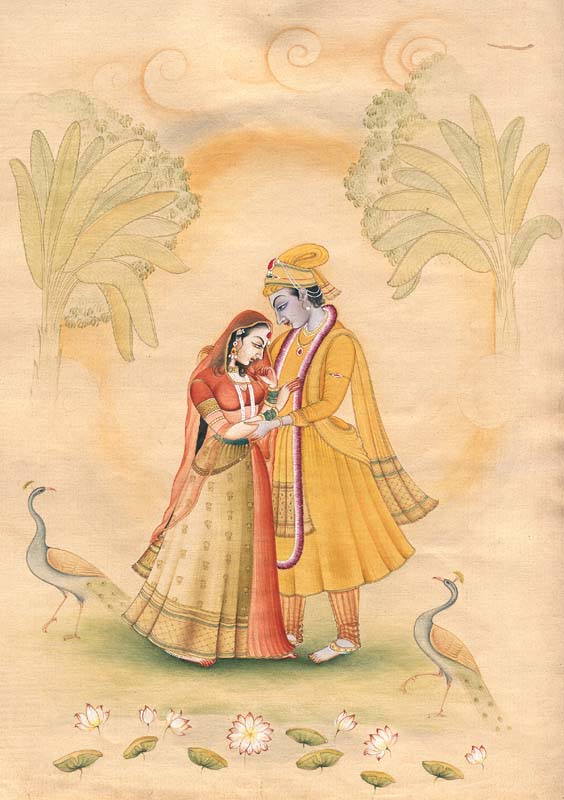
There are both differences and non-differences between Yeshu of Nazareth and Siddhartha Gautama; between Muhammad and Guru Nanak; between Sri Krishna and Abraham; between Vardhamana and Kongfutzu; between Zarathustra and Ramana Maharshi. Each is different, because each has limitations as well as advantages; each is non-different, because each can act as the ishta-guru, or 'chosen guru', the spiritual friend. The charge of 'relativism' does not apply, since differences are acknowledged. The charge of 'exclusivism' does not apply, since non-differences are acknowledged. And if none of the above seem worthy of being a spiritual friend, then an infinite number of other events awaits your attention.
25 February 2007
The Life of the Prophet
The life of the prophet is like that of someone walking upon a rope: matter on one side and spirit on the other; heaven on one side and earth on the other; the imperfect self journeying towards perfection and at the same time bearing the burden of numberless souls, many of whom have not yet learned to walk even upon the earth. In the history of the prophets, at whatever time they have come on earth, one reads of their struggle being fourfold: struggle with self, struggle with the world, struggle with friends, and struggle with foes; and yet many wonder why a prophet should be a warrior! Most people know that the Prophet Muhammad was a warrior, but are unaware of the fact that Moses had the same experience; and very few know that the whole lives of the prophets of India, Rama and Krishna, were nothing but warfare from beginning to end. Their scriptures are full of the wars and battles that went on all through their lives, and if some prophets apparently did not have to wage war, then they had some other form of warfare to go through. The blood of the martyrs was the foundation of the Church.
-- Hazrat Inayat Khan
-- Hazrat Inayat Khan
24 February 2007
The Fourth Truth
The Third Truth
And this is the Third Truth of the Fall of Bhaya and the Rise of Abhaya: the remainderless fading and dimming, renunciation, relinquishment, release, and defeat of that very bhaya; and the absolute appearance and brightening, engagement, embodiment, incorporation, and victory of that very abhaya. That is, to shine as the Heart dims that very bhaya; to fight at the side of the Beloved defeats that very bhaya. To shine as the Heart brightens that very abhaya; to fight at the side of the Beloved is the victory of that very abhaya.
23 February 2007
Four Functions for All Humans
Vayu (air): to study and teach
Agni (fire): to shine and fight
Prithvi (earth): to make and art
Apas (water): to serve and heal
Agni (fire): to shine and fight
Prithvi (earth): to make and art
Apas (water): to serve and heal
The Second Truth
And this is the Second Truth of the Rise of Bhaya: to forget to shine, and to abandon the fight, lead to bhaya. That is, to forget to shine as the Heart leads to bhaya; and to abandon the fight at the side of the Beloved leads to bhaya.
22 February 2007
The First Truth
This is the First Truth of Bhaya: bhaya afflicts birth, bhaya afflicts aging, bhaya afflicts death; bhaya afflicts sorrow and celebration, lamentation and praise, pain and pleasure, grief and joy, and despair and hope; bhaya afflicts association with the loved and unbeloved; bhaya afflicts separation from the loved and unbeloved; bhaya afflicts getting what is wanted and what is unwanted. In short, bhaya afflicts all phenomena.
15 February 2007
The Ways Diverse and Unified

The Way of the Jivanta: knowledge of the natural world
The Way of the Buddha: satsang with the Awakened Ones
The Way of the Beloved: ascesis from the Divine Lord
The Way of the Heart: trust in the Unconditioned
Out and In
The Heart is neither transcendent nor immanent.
The Beloved is fully transcendent.
The Buddha is fully transcendent and immanent.
The Jivanta is fully immanent.
The breath-cycle replicates the nature of reality.
Breathing-in mirrors the Jivanta.
The stillness-after-breathing-in mirrors the Buddha.
Breathing-out mirrors the Beloved.
The stillness-after-breathing-out mirrors the Heart.
Each breath is communion.
Awareness of the breath awakens the Heart.
The Beloved is fully transcendent.
The Buddha is fully transcendent and immanent.
The Jivanta is fully immanent.
The breath-cycle replicates the nature of reality.
Breathing-in mirrors the Jivanta.
The stillness-after-breathing-in mirrors the Buddha.
Breathing-out mirrors the Beloved.
The stillness-after-breathing-out mirrors the Heart.
Each breath is communion.
Awareness of the breath awakens the Heart.
10 February 2007
We're all Buddhists Now
Buddham saranam gacchami: I take refuge in the Buddha
Dhammam saranam gacchami: I take refuge in the Dhamma
Sangham saranam gacchami: I take refuge in the Sangha
"Official" Buddhists take refuge in the Triple Gem, by reciting some version of the Threefold Refuge. The Refuge, though, also has meaning that transcends religious boundaries. Christians take refuge in Christ, Muslims in Muhammad (which is not to say that Muslims see Muhammad as divine, however), Jews in Moses (since Mosaic, and not some other person's, law is followed by Jews), Vaishnavas in Vishnu, for instance. Christians take refuge in the Gospel, Muslims in the Qur'an, Jews in the Torah, Vaishnavas in the Srimad Bhagavatam, and so on. Christians finally take refuge in the Church, Muslims in the Ummah, Jews in the Minyan, Vaishnavas in Satsang, et cetera.
Dhammam saranam gacchami: I take refuge in the Dhamma
Sangham saranam gacchami: I take refuge in the Sangha
"Official" Buddhists take refuge in the Triple Gem, by reciting some version of the Threefold Refuge. The Refuge, though, also has meaning that transcends religious boundaries. Christians take refuge in Christ, Muslims in Muhammad (which is not to say that Muslims see Muhammad as divine, however), Jews in Moses (since Mosaic, and not some other person's, law is followed by Jews), Vaishnavas in Vishnu, for instance. Christians take refuge in the Gospel, Muslims in the Qur'an, Jews in the Torah, Vaishnavas in the Srimad Bhagavatam, and so on. Christians finally take refuge in the Church, Muslims in the Ummah, Jews in the Minyan, Vaishnavas in Satsang, et cetera.
Days, Planets, Buddhas
Sunday: Sun: Dattatreya
Monday: Moon: Radha-Krishna
Tuesday: Mars: Yeshu
Wednesday: Mercury: Siddhartha Gautama
Thursday: Jupiter: Guru Nanak
Friday: Venus: Muhammad
Saturday: Saturn: Abraham
Monday: Moon: Radha-Krishna
Tuesday: Mars: Yeshu
Wednesday: Mercury: Siddhartha Gautama
Thursday: Jupiter: Guru Nanak
Friday: Venus: Muhammad
Saturday: Saturn: Abraham
08 February 2007
I Bind You Together
Have your eating and drinking in common. I bind you together. Assemble for worship of the Lord, like spokes around a hub. Of one mind and one purpose I make you, following one leader. Be like the Gods, ever deathless! Never stop loving!
Atharva Veda 3.30.6-7. VE
05 February 2007
H3
What is "religion"?
Among the definitions given here, definition number four looks to be the basic definition from which sprung all the others.
"Re-" prefix carries a particular meaning, "again" or "back". To bind again implies that a prior binding, or union, existed.
To practice religion is to re-connect with what you had lost. The need to practice religion implies that one is not fully whole, that there is something missing. In Eastern Orthodox Christian terms, what was lost was the intimate communion with God in the Garden of Eden; and Jesus Christ becomes the way by which the communion is not simply restored but also cultivated and perfected. In Meher Baba's theo-cosmology, what was lost was unity with God; and Meher Baba becomes the way by which that unity is not simply restored but also cultivated and perfected. I'm not too sure about the Orthodox position on this issue, but for Meher Baba, the priori unity of God was an unconscious unity. God wanted to become conscious, and thus asked "Who am I?", simultaneously leading to the creation of the cosmos and of living beings within, and a part of, that cosmos. Living beings then evolve their separate centers of awareness, from atoms on up to mankind. Mankind is then able to evolve in spiritual awareness, into re-union with God, but now this new God-Union (unlike the prior unconscious unity) is filled with awareness.
Religion can be seen as the process of making whole, of re-uniting separate parts.
Something that has healed is now whole. Both "whole" and "heal"; as well as "holy" and "hallow", as in "Hallowed be Thy name"; come from the same Indo-European root "kailo", "whole", "uninjured".
Religion then, essentially, is truly "holy": healing, health, and wholeness, whether physically, energetically, emotionally, intellectually, or spiritually.
Among the definitions given here, definition number four looks to be the basic definition from which sprung all the others.
4. A cause, principle, or activity pursued with zeal or conscientious devotion.Beliefs about supernatural powers would then represent one, common way that people can be inspired to zealous devotion. Why this zeal? What's the purpose?
Middle English religioun, from Old French religion, from Latin religi"Religion" likely evolved from the Latin verb "religare", "to tie fast", or "to tightly connect", or "to bind again"., religi
re, to tie fast.
Latin religFrom "religare" comes the English word "rely". From "ligare" comes words like "ligate", "oblige", and "league".
"Re-" prefix carries a particular meaning, "again" or "back". To bind again implies that a prior binding, or union, existed.
To practice religion is to re-connect with what you had lost. The need to practice religion implies that one is not fully whole, that there is something missing. In Eastern Orthodox Christian terms, what was lost was the intimate communion with God in the Garden of Eden; and Jesus Christ becomes the way by which the communion is not simply restored but also cultivated and perfected. In Meher Baba's theo-cosmology, what was lost was unity with God; and Meher Baba becomes the way by which that unity is not simply restored but also cultivated and perfected. I'm not too sure about the Orthodox position on this issue, but for Meher Baba, the priori unity of God was an unconscious unity. God wanted to become conscious, and thus asked "Who am I?", simultaneously leading to the creation of the cosmos and of living beings within, and a part of, that cosmos. Living beings then evolve their separate centers of awareness, from atoms on up to mankind. Mankind is then able to evolve in spiritual awareness, into re-union with God, but now this new God-Union (unlike the prior unconscious unity) is filled with awareness.
Religion can be seen as the process of making whole, of re-uniting separate parts.
Something that has healed is now whole. Both "whole" and "heal"; as well as "holy" and "hallow", as in "Hallowed be Thy name"; come from the same Indo-European root "kailo", "whole", "uninjured".
Religion then, essentially, is truly "holy": healing, health, and wholeness, whether physically, energetically, emotionally, intellectually, or spiritually.
03 February 2007
The Magician
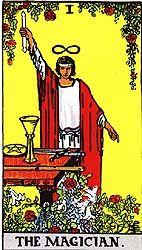
The Magician
A youthful figure in the robe of a magician, having the countenance of divine Apollo, with smile of confidence and shining eyes. Above his head is the mysterious sign of the Holy Spirit, the sign of life, like an endless cord, forming the symbol for infinity, or the figure 8 in a horizontal position. About his waist is a serpent-cincture, the serpent appearing to devour its own tail. This is familiar to most as a conventional symbol of eternity, but here it indicates more especially the eternity of attainment in the spirit. In the Magician's right hand is a wand raised towards heaven, while the left hand is pointing to the earth. This dual sign is known in very high grades of the Instituted Mysteries; it shows the descent of grace, virtue and light, drawn from things above and derived to things below. The suggestion throughout is therefore the possession and communication of the Powers and Gifts of the Spirit. On the table in front of the Magician are the symbols of the four Tarot suits, signifying the elements of natural life, which lie like counters before the adept, and he adapts them as he wills. Beneath are roses and lilies, the flos campi and lilium convallium, changed into garden flowers, to show the culture of aspiration. This card signifies the divine motive in man, reflecting God, the will in the liberation of its union with that which is above. It is also the unity of individual being on all planes, and in a very high sense it is thought, in the fixation thereof. With further reference to what I have called the sign of life and its connection with the number 8, it may be remembered that Christian Gnosticism speaks of rebirth in Christ as a change "unto the Ogdoad." The mystic number is termed Jerusalem above, the Land flowing with Milk and Honey, the Holy Spirit and the Land of the Lord. According to Martinism, 8 is the number of Christ.
The Ocean of Fire
Mind has the habit of getting exalted, and then going down. Sometimes it is full of doubt. So, in one's spirit of trying to seek Truth, one sometimes gets in a mess and feels dry at heart. God and love for God are not child's play. In love, you have to be ready to drown yourself in the ocean of fire.
Jesus was never serious about anything, except about God, whose incarnation he was. He was serious about himself and God, with whom he was one. Otherwise, he was so lighthearted that he even got crucified for others, with the same lightness of heart. Why? Because he had no wants at all. He did not want, he gave. So the only thing that God wants is not ceremony, not yogas. He wants love, the love that makes you forget yourself in him.
Do you know that Jesus told his disciples, "Leave everything and follow me"?....So unless and until you are wholeheartedly prepared to follow someone who you think true, like Jesus, the best thing for you would be not to submit to anyone. Just go on following the inner voice. Can you surrender absolutely...? Just ask yourself. Be honest to the very core. If not, do not bother about it.
-- Meher Baba; 16 May 1952; Myrtle Beach, South Carolina29 January 2007
The One and the All
Stick To One Guru
From a doctor, you get a prescription. From two doctors, you get consultation. From three doctors, you get your own cremation. Even so, if you have many Gurus, you will be bewildered. You will be at a loss to know what to do. One Guru will tell you: “Do Soham Japa.” Another will tell you: “Do Japa of Sri Ram.” A third Guru will tell you: “Hear Anahata sounds.” You will be puzzled. Stick to one Guru and follow his instructions.
Listen to all, but follow one. Respect all, but adore one. Gather knowledge from all, but adopt the teachings of one Master. Then you will have rapid spiritual progress.
28 January 2007
Easy Yoga
Etymologically, the Sanskrit "yoga" is related to the English "yoke". The English "to yoke" means "to unite". The Sanskrit "yoga" includes the meaning of "unite", as well as other meanings, like "method", "way", and "work". The way of the Heart can thus be named "Hridaya-Yoga"; the method of the Buddha, "Buddha-Yoga". (Or, when speaking of the universal Way or Method common to all Beings, we may simply say "Yoga", and one who practices this Method or walks this Way, a "Yogi".) When Jesus talks about His own form of "yoga", the word He uses is usually translated as "yoke". Since the English "yoke" lacks the depth of meanings associated with its genetic relative "yoga", it might be insightful to take a Sanskritic view of Jesus' statement. Thus, we may modify Matthew 11:28-30 (KJV):
28Come unto me, all ye that labour and are heavy laden, and I will give you rest.
29Take my yoga upon you, and learn of me; for I am meek and lowly in heart: and ye shall find rest unto your souls.
30For my yoga is easy, and my burden is light.
26 January 2007
Jai Jesus!
If we assume that sounds are not arbitrary, that human speech especially forms a link to an inherent meaning, that the elements of language actually possess innate transformative potential, what would that mean for understanding our different spiritualities, our different religions?
For instance, take Sanskrit and English. Does the Sanskrit "je" sound , and the meanings associated in Sanskrit with that sound, have anything to tell us about English words containing the "je" sound?
What about the word "Jesus"? What does Sanskritic syllabic meaning say about "Jesus"? (I sound out vowels such as "e" as the ancient Latins did, as a short "eh" [e.g., the "e" in "fell"] or as a long "eh" [e.g., the "a" in "fate"]. Some English speakers pronounce the "je" in "Jesus" like the "jay" in "blue-jay", so "je" can be seen to form a part of "Jesus".)
There's a Sanskrit verb root "ji" (rhymes with "she"). One form of this verb is "jés·as". The dot after the first "s" should actually be below the "s"; and the final "a" would probably be pronounced like "uh" as in the "u" in "up"; making "jés·as" sound very much like how the word "Jesus" is pronounced.
For instance, take Sanskrit and English. Does the Sanskrit "je" sound , and the meanings associated in Sanskrit with that sound, have anything to tell us about English words containing the "je" sound?
What about the word "Jesus"? What does Sanskritic syllabic meaning say about "Jesus"? (I sound out vowels such as "e" as the ancient Latins did, as a short "eh" [e.g., the "e" in "fell"] or as a long "eh" [e.g., the "a" in "fate"]. Some English speakers pronounce the "je" in "Jesus" like the "jay" in "blue-jay", so "je" can be seen to form a part of "Jesus".)
There's a Sanskrit verb root "ji" (rhymes with "she"). One form of this verb is "jés·as". The dot after the first "s" should actually be below the "s"; and the final "a" would probably be pronounced like "uh" as in the "u" in "up"; making "jés·as" sound very much like how the word "Jesus" is pronounced.
"Jés·as", then, comes out of "ji". And the infinitive form of "ji" carries several meanings, "to conquer, to win, to defeat, to excel, to vanquish, to overcome any hardship or difficulty". From "ji" thus comes "Jai!" or "Jaya!", both meaning "Victory!", as in "Jai Ma!", "Glory to the Divine Mother!", or "Jai Dev!", "Glory to God!" When Christians, or anyone else, then, shouts "Jesus!", they are shouting for victory, for overcoming any hardship, for besting any suffering -- even in the very midst of loss, hardship, and suffering. To shout "Jesus!" is to throw your hat into the ring, with the intent to win, even if you have to lose.
23 January 2007
The Golden Rule
Sutrakritanga: Book I: Lecture 11: 33:
Indifferent to worldly objects, a man should wander about treating all creatures in the world so as he himself would be treated.
(Also found in: Jaina Sutras. Translated from Prakrit by Hermann Jacobi. 2 Volumes. New York: Dover Publications, Inc., 1968. Vol. 2: 314.)
The Golden Rule of Christianity ("Do unto others as you would have them do unto you") expresses the basic idea also found in the Jain-Hindu-Buddhist concept of "ahimsa", or "non-harming".
Indifferent to worldly objects, a man should wander about treating all creatures in the world so as he himself would be treated.
(Also found in: Jaina Sutras. Translated from Prakrit by Hermann Jacobi. 2 Volumes. New York: Dover Publications, Inc., 1968. Vol. 2: 314.)
The Golden Rule of Christianity ("Do unto others as you would have them do unto you") expresses the basic idea also found in the Jain-Hindu-Buddhist concept of "ahimsa", or "non-harming".
21 January 2007
Yamas & Niyamas
The Ten Yamas:
1. Ahimsa
2. Satya
3. Asteya
4. Brahmacharya
5. Kshama
6. Dhriti
7. Daya
8. Arjava
9. Mitahara
10. Shaucha
The Ten Niyamas:
1. Hri
2. Santosha
3. Dana
4. Astikya
5. Ishvara-Pujana
6. Siddhanta Shravana
7. Mati
8. Vrata
9. Japa
10. Tapas
In the coming days, I'll explore what these yamas and niyamas have to say to modern men and women.
1. Ahimsa
2. Satya
3. Asteya
4. Brahmacharya
5. Kshama
6. Dhriti
7. Daya
8. Arjava
9. Mitahara
10. Shaucha
The Ten Niyamas:
1. Hri
2. Santosha
3. Dana
4. Astikya
5. Ishvara-Pujana
6. Siddhanta Shravana
7. Mati
8. Vrata
9. Japa
10. Tapas
In the coming days, I'll explore what these yamas and niyamas have to say to modern men and women.
Aum Namah Jivantayah
"Jivanta" means "that which is alive, and that which is living". From the Heart and the Beloved comes forth Jivanta, all that is alive: the light, the atoms, the molecules, the stars, the seas, the land, the sky, the plants, the animals, the men, and the women. The presence of men and women then makes possible the appearance of the Buddha, who then points directly back to the Heart and the Beloved.
Aum namah Jivantayah: I venerate all living beings.
Aum namah Jivantayah: I venerate all living beings.
Aum Namah Buddhayah
According to classical Buddhism, the "Buddha" is the one who has most fully realized and manifested wisdom and compassion.
If we take the most basic meaning of "Buddha" as "one who is Awake and Aware", then the number of Buddhas we have known becomes potentially endless. I'll just name a few Buddhas I've known:
Zarathustra
Krishna
Abraham
Vardhamana
Siddhartha Gautama
Kongfutzu
Yeshu
Muhammad
Guru Nanak
Aum namah Buddhayah: I venerate the Buddha in us all.
If we take the most basic meaning of "Buddha" as "one who is Awake and Aware", then the number of Buddhas we have known becomes potentially endless. I'll just name a few Buddhas I've known:
Zarathustra
Krishna
Abraham
Vardhamana
Siddhartha Gautama
Kongfutzu
Yeshu
Muhammad
Guru Nanak
Aum namah Buddhayah: I venerate the Buddha in us all.
Active Presence
The Heart is the Infinite Essence, the Merciful, the Compassionate, the Mother. The Heart gives birth to the Beloved, the Creator, the Lord, the Father. Taking refuge in one means taking refuge in the other.
To take refuge means to keep the relationship growing, to keep communications open. One gradually renounces all that diminishes the relationship, and steadily cultivates all that supports the relationship. The Heart and the Beloved are ever-present. Whether they are actively-present depends upon you, your faith, your listening, and your doing.
To take refuge means to keep the relationship growing, to keep communications open. One gradually renounces all that diminishes the relationship, and steadily cultivates all that supports the relationship. The Heart and the Beloved are ever-present. Whether they are actively-present depends upon you, your faith, your listening, and your doing.
20 January 2007
Vallabham Saranam Gacchami
Vallabha means Beloved. Unlike Sri Sankara, Sri Vallabhacharya posited that only God is real, and rejected the notion of maya (or the "illusory power of God"), since to assume the existence of maya would violate God's utter sole reality.
Vallabham saranam gacchami: I take refuge with the Beloved.
Vallabham saranam gacchami: I take refuge with the Beloved.
16 January 2007
Hridayam Saranam Gacchami
The Buddhist practice of Refuge takes the not-yet-Buddhist into the realm of the Buddhas. By having taken Refuge, the newly-born-Buddhist has placed his or her ultimate trust in the Buddha (the Realizer), the Dharma (the Revelation), and the Sangha (the Community).
Buddham saranam gacchami: I take refuge in the Buddha.
Dharmam saranam gacchami: I take refuge in the Dharma.
Sangham saranam gacchami: I take refuge in the Sangha.
The Buddha is one who has realized the Heart (Sanskrit, "Hridayam").
Hridayam saranam gacchami: I take refuge in the Heart.
Buddham saranam gacchami: I take refuge in the Buddha.
Dharmam saranam gacchami: I take refuge in the Dharma.
Sangham saranam gacchami: I take refuge in the Sangha.
The Buddha is one who has realized the Heart (Sanskrit, "Hridayam").
Hridayam saranam gacchami: I take refuge in the Heart.
04 January 2007
Science and Wisdom
Parable Of Four Learned Scholars
Once four learned scholars-an Ayurvedic doctor, an astrologer, a musician and a logician-had to spend a day at a village; and each was highly learned in his own science, a very great authority in his own subject but empty of wisdom concerning life.
Now they went about collecting articles for their food, and the Ayurvedic doctor went to buy some vegetables. But he soon walked back home with empty hands, for his medical knowledge concerning the food-value of vegetables would not allow him to choose any. The potato was harmful as it would cause wind, while onion was too Tamasic and so did all other vegetables prove defective. And none was suitable for food.
The astrologer climbed a coconut tree to fetch a coconut for cooking. While he was climbing down, a donkey from a nearby house brayed, and lo, the astrologer stood on half-way down the tree, deciding at once to work out the astrological consequences of this donkey's braying! And he thus stood on... ,
The musician's history was yet more pathetic and ridiculous. He was watching the pot in which the rice was being cooked; the water was boiling, and soon a rhythmic sound emanated from the boiling-pot. The musician, true and loyal to his knowledge of music, at once began marking time; but would the sound of the boiling-pot conform to the known laws of music? Soon the musician was beside himself in a fit of anger and broke the pot with the ladle, and lo the rice fell over the ground and was lost.
The logician was none the better for his erudition. He was returning with a cup full of ghee and en route, it struck his logic-loving mind to test and verify whether the cup supported the ghee or the ghee did the cup. He at once turned the cup upside down, and lo, the ghee fell on the ground, and was soon lost. Grief-stricken at the loss, yet the logician congratulated himself at the findings concerning the cup and the ghee and walked back home lost in thoughts of logic.
Be ye not merely learned, but become ye truly wise. For more learning will not bestow on you an iota of real happiness. Wisdom is bliss. Book-learning is lifeless knowledge; experience and true wisdom should be acquired through service of a Guru, studying under him and following his instructions in their true spirit.
Once four learned scholars-an Ayurvedic doctor, an astrologer, a musician and a logician-had to spend a day at a village; and each was highly learned in his own science, a very great authority in his own subject but empty of wisdom concerning life.
Now they went about collecting articles for their food, and the Ayurvedic doctor went to buy some vegetables. But he soon walked back home with empty hands, for his medical knowledge concerning the food-value of vegetables would not allow him to choose any. The potato was harmful as it would cause wind, while onion was too Tamasic and so did all other vegetables prove defective. And none was suitable for food.
The astrologer climbed a coconut tree to fetch a coconut for cooking. While he was climbing down, a donkey from a nearby house brayed, and lo, the astrologer stood on half-way down the tree, deciding at once to work out the astrological consequences of this donkey's braying! And he thus stood on... ,
The musician's history was yet more pathetic and ridiculous. He was watching the pot in which the rice was being cooked; the water was boiling, and soon a rhythmic sound emanated from the boiling-pot. The musician, true and loyal to his knowledge of music, at once began marking time; but would the sound of the boiling-pot conform to the known laws of music? Soon the musician was beside himself in a fit of anger and broke the pot with the ladle, and lo the rice fell over the ground and was lost.
The logician was none the better for his erudition. He was returning with a cup full of ghee and en route, it struck his logic-loving mind to test and verify whether the cup supported the ghee or the ghee did the cup. He at once turned the cup upside down, and lo, the ghee fell on the ground, and was soon lost. Grief-stricken at the loss, yet the logician congratulated himself at the findings concerning the cup and the ghee and walked back home lost in thoughts of logic.
Be ye not merely learned, but become ye truly wise. For more learning will not bestow on you an iota of real happiness. Wisdom is bliss. Book-learning is lifeless knowledge; experience and true wisdom should be acquired through service of a Guru, studying under him and following his instructions in their true spirit.
01 January 2007
So What?
God Exists, So What?
"Yes, I believe God exists," you say: "What should I do about it?" Endeavour to realise Him.
He must be more real to you than all the objects of the world.
For that you must serve humanity and love God. Meditate on Him in Brahmamuhurta.
Sing Kirtan.
Do Japa.
Lead a virtuous life, for He is the witness of all your thoughts, words and deeds.
Be truthful; cheat not anybody.
Love all; harm not anybody.
Be kind to all; for God dwells in all. And, thus realise Him here and now.
May God bless you!
SWAMI SIVANANDA.
"Yes, I believe God exists," you say: "What should I do about it?" Endeavour to realise Him.
He must be more real to you than all the objects of the world.
For that you must serve humanity and love God. Meditate on Him in Brahmamuhurta.
Sing Kirtan.
Do Japa.
Lead a virtuous life, for He is the witness of all your thoughts, words and deeds.
Be truthful; cheat not anybody.
Love all; harm not anybody.
Be kind to all; for God dwells in all. And, thus realise Him here and now.
May God bless you!
SWAMI SIVANANDA.
31 December 2006
The Name of God
The Name of God
BRAHMA
SARASWATI
ABBA
AMMA
VISHNU
LAKSHMI
FATHER
MOTHER
SHIVA
SHAKTI
Who give birth to
BUDDHA
DHAMMA
SON
DAUGHTER
RISHI
VEDA
CHRISTOS
SOPHIA
SIDDHA
VIDYA
In short,
the Marriage of RADIANCE and WISDOM, Father and Mother,
gives birth to
the AWAKENED ONE and the COSMOS, Son and Daughter
BRAHMA
SARASWATI
ABBA
AMMA
VISHNU
LAKSHMI
FATHER
MOTHER
SHIVA
SHAKTI
Who give birth to
BUDDHA
DHAMMA
SON
DAUGHTER
RISHI
VEDA
CHRISTOS
SOPHIA
SIDDHA
VIDYA
In short,
the Marriage of RADIANCE and WISDOM, Father and Mother,
gives birth to
the AWAKENED ONE and the COSMOS, Son and Daughter
28 December 2006
Revati
There are two main theories of the after-life: (1) you have one chance, and then it's eternal hell or eternal heaven; or (2) you have many chances, and neither heaven nor hell is eternal.
One attraction the "one-life-only"-idea possesses is that, if you 'get right with God', then this is your only lifetime on earth, and you have eternity in heaven.
One attraction the "many-lives-possible"-idea possesses is that, if you don't 'get right with God', then this isn't your only lifetime, and you don't have to spend eternity in hell.
The synthesis of both is this: God transcends both heaven and hell -- thus, take your stand in the presence of God in this very moment.
One attraction the "one-life-only"-idea possesses is that, if you 'get right with God', then this is your only lifetime on earth, and you have eternity in heaven.
One attraction the "many-lives-possible"-idea possesses is that, if you don't 'get right with God', then this isn't your only lifetime, and you don't have to spend eternity in hell.
The synthesis of both is this: God transcends both heaven and hell -- thus, take your stand in the presence of God in this very moment.
26 December 2006
The Death of Death
In the Christian tradition, Christmas sets in motion the events of Easter: Christmas makes sense only in the context of that latter day. Easter can be seen as a kind of ultimate Christmas, a 'glorified' Christmas: "O death, where is thy sting? O grave, where is thy victory?" (1st Corinthians 15:55)
Markandeya
Markandeya was a great devotee of Lord Siva. His father Mrikandu had performed rigorous austerities to get a son. Lord Siva appeared before him and said: “O Rishi, do you want a good son who will die in his sixteenth year or a bad and foolish son who will live for a long time?” Mrikandu replied: “O my venerable Lord, let me have a good son”.
The boy came to know about his fate and began to worship Lord Siva whole-heartedly with intense faith and devotion. The boy entered into deep meditation and Samadhi on the day decreed as the day of his death. The messengers of Lord Yama were not able to approach him. Hence, Yama himself went to take away his life. The boy prayed to Lord Siva for protection and embraced the Linga [an iconic representation of Lord Siva]. Then Yama threw his noose round the Linga and the boy. Lord Siva came out of the Linga immediately and killed Yama to protect the boy. Lord Siva was called Mrityunjaya [Conqueror of Death] and Kala-kala [Destroyer of Time] from that day.
Then the Devas approached Lord Siva and said: “O adorable Lord, salutations unto Thee. Pardon Yama for his mistake. O Ocean of Mercy, bring him back to life”. Then Lord Siva brought Yama back to life at the request of the gods. He also conferred a boon to the boy Markandeya that he should live for ever as a boy of sixteen years of age. He is a Chiranjivi. In South India, even now men and women bless a boy when he does prostration to them: “Live as a Chiranjivi like Markandeya”.
Through Tapas and meditation you can achieve anything in the three worlds.
Markandeya
Markandeya was a great devotee of Lord Siva. His father Mrikandu had performed rigorous austerities to get a son. Lord Siva appeared before him and said: “O Rishi, do you want a good son who will die in his sixteenth year or a bad and foolish son who will live for a long time?” Mrikandu replied: “O my venerable Lord, let me have a good son”.
The boy came to know about his fate and began to worship Lord Siva whole-heartedly with intense faith and devotion. The boy entered into deep meditation and Samadhi on the day decreed as the day of his death. The messengers of Lord Yama were not able to approach him. Hence, Yama himself went to take away his life. The boy prayed to Lord Siva for protection and embraced the Linga [an iconic representation of Lord Siva]. Then Yama threw his noose round the Linga and the boy. Lord Siva came out of the Linga immediately and killed Yama to protect the boy. Lord Siva was called Mrityunjaya [Conqueror of Death] and Kala-kala [Destroyer of Time] from that day.
Then the Devas approached Lord Siva and said: “O adorable Lord, salutations unto Thee. Pardon Yama for his mistake. O Ocean of Mercy, bring him back to life”. Then Lord Siva brought Yama back to life at the request of the gods. He also conferred a boon to the boy Markandeya that he should live for ever as a boy of sixteen years of age. He is a Chiranjivi. In South India, even now men and women bless a boy when he does prostration to them: “Live as a Chiranjivi like Markandeya”.
Through Tapas and meditation you can achieve anything in the three worlds.
25 December 2006
Luke, Chapter 2 (New International Version)

Luke 2
The Birth of Jesus
1In those days Caesar Augustus issued a decree that a census should be taken of the entire Roman world. 2(This was the first census that took place while Quirinius was governor of Syria.) 3And everyone went to his own town to register.4So Joseph also went up from the town of Nazareth in Galilee to Judea, to Bethlehem the town of David, because he belonged to the house and line of David. 5He went there to register with Mary, who was pledged to be married to him and was expecting a child. 6While they were there, the time came for the baby to be born, 7and she gave birth to her firstborn, a son. She wrapped him in cloths and placed him in a manger, because there was no room for them in the inn.
The Shepherds and the Angels
8And there were shepherds living out in the fields nearby, keeping watch over their flocks at night. 9An angel of the Lord appeared to them, and the glory of the Lord shone around them, and they were terrified. 10But the angel said to them, "Do not be afraid. I bring you good news of great joy that will be for all the people. 11Today in the town of David a Savior has been born to you; he is Christ the Lord. 12This will be a sign to you: You will find a baby wrapped in cloths and lying in a manger."13Suddenly a great company of the heavenly host appeared with the angel, praising God and saying,
14"Glory to God in the highest,
and on earth peace to men on whom his favor rests."
15When the angels had left them and gone into heaven, the shepherds said to one another, "Let's go to Bethlehem and see this thing that has happened, which the Lord has told us about."
16So they hurried off and found Mary and Joseph, and the baby, who was lying in the manger. 17When they had seen him, they spread the word concerning what had been told them about this child, 18and all who heard it were amazed at what the shepherds said to them. 19But Mary treasured up all these things and pondered them in her heart. 20The shepherds returned, glorifying and praising God for all the things they had heard and seen, which were just as they had been told.
A Christmas Creed
Look! Yesu Christos, the Foe-Destroyer,
Was conceived by the Spirit, born of the Almah Mary,
Suffered under Pontius Pilate, was crucified, died, and was buried.
He went into the underworlds.
On the third day, He was Resurrected;
He Ascended into the overworlds, and sits at the right hand of the Beloved, saying,
“As you sow, so shall you reap.”
I believe in Holy Nature;
I believe in the Sacred Universal Communion of Light, Atoms, Molecules, Minerals, Plants, Animals, and Man;
and in the Communion of Saints, Sages, and Siddhas;
The Forgiveness of sins,
The Marriage of Consciousness and Energy,
And the Life everlasting. Amen.
22 December 2006
Bridges Across the Divide
Not too many people know how large an influence the Catholic tradition had upon the Protestant evangelical author of the best-seller The Purpose Driven Life. The current interest in Catholic spiritually among Protestants stems from many reasons (as the excerpt below from The National Catholic Reporter, 15 December, 2006, shows; registration and subscription necessary to see the whole article). The trend of the Protestant, especially Reformed, tradition has been away from orality, away from the senses, away from contemplation, away from mysticism. Yet, if the Protestant experiment is to survive, it must retrieve these essential elements, elements that are truly 'universal', or 'catholic' (from the Greek, 'kata holos', 'relating to the whole').
Rick Warren, evangelical pastor of Saddleback Church in Lake Forest, Calif., told NCR that classical Catholic spiritual literature had a strong impact on him in writing The Purpose Driven Life, his Christian advice book that was on The New York Times Bestseller List for 174 weeks.
In 2005 this book made headlines when Ashley Smith, a 26-year-old hostage of the Atlanta Courthouse killer notified police that her captor wanted to turn himself in, claiming that during her captivity she read to the killer Brian Nichols from The Purpose Driven Life.
Newsweek magazine called Warren one of “15 People Who Make America Great,” an award given to people genius or passion, devote themselves to helping others. Christianity Today dubbed him “America’s most influential pastor” in a 2002 cover story.
Warren gives away 90 percent of his income to charities. His church is attended by as many as 20,000 on Sundays and carries 80,000 on the rolls. Elements from Catholic spirituality are a feature of many of the church’s Sunday workshops and classes, he said.
With roots in the Southern Baptist tradition, Warren said he has depended upon concepts from his readings in Catholic spirituality to form his own vision for his church.
“The idea of dying to self is a strong theme that comes from classical Catholic spirituality, as well as the instruction to learn to pray without ceasing. In St. John of the Cross we find the notion of the soul’s dark night, emphasizing the importance of how you handle those times when God seems absent or silent. Thomas à Kempis’ Imitation of Christ, is a Catholic spiritual classic I have found useful. How does a book last 500 years?”
From the early church fathers and mothers through the monastic traditions and up to Henri Nouwen and Thomas Merton, Warren said these traditions and writings have all ministered to him.
“Fr. Nouwen’s concept of the ‘wounded healer’ has informed my pastoral career. Here was a man who clearly struggled with his faith. His authenticity comes through.”
Warren quoted St. Augustine’s famous sentence, “Our hearts are restless until they find rest in you,” saying he believes that longing for the transcendent God is the source of his congregation’s interest in spirituality.
“People have tried everything. They realize there’s a hole in their hearts, knowing instinctively there’s more to life than just the material. There’s a spiritual yearning that all the technology and gadgets in the world can’t satisfy.”
In the classes taught at Saddleback Church, Warren said, six different ways to meditate are presented, along with instructions on how to fashion a daily devotional time. “We teach prayer, fasting, solitude. These are tools and resources for reaching out, for accomplishing our mission.”
Rick Warren, evangelical pastor of Saddleback Church in Lake Forest, Calif., told NCR that classical Catholic spiritual literature had a strong impact on him in writing The Purpose Driven Life, his Christian advice book that was on The New York Times Bestseller List for 174 weeks.
In 2005 this book made headlines when Ashley Smith, a 26-year-old hostage of the Atlanta Courthouse killer notified police that her captor wanted to turn himself in, claiming that during her captivity she read to the killer Brian Nichols from The Purpose Driven Life.
Newsweek magazine called Warren one of “15 People Who Make America Great,” an award given to people genius or passion, devote themselves to helping others. Christianity Today dubbed him “America’s most influential pastor” in a 2002 cover story.
Warren gives away 90 percent of his income to charities. His church is attended by as many as 20,000 on Sundays and carries 80,000 on the rolls. Elements from Catholic spirituality are a feature of many of the church’s Sunday workshops and classes, he said.
With roots in the Southern Baptist tradition, Warren said he has depended upon concepts from his readings in Catholic spirituality to form his own vision for his church.
“The idea of dying to self is a strong theme that comes from classical Catholic spirituality, as well as the instruction to learn to pray without ceasing. In St. John of the Cross we find the notion of the soul’s dark night, emphasizing the importance of how you handle those times when God seems absent or silent. Thomas à Kempis’ Imitation of Christ, is a Catholic spiritual classic I have found useful. How does a book last 500 years?”
From the early church fathers and mothers through the monastic traditions and up to Henri Nouwen and Thomas Merton, Warren said these traditions and writings have all ministered to him.
“Fr. Nouwen’s concept of the ‘wounded healer’ has informed my pastoral career. Here was a man who clearly struggled with his faith. His authenticity comes through.”
Warren quoted St. Augustine’s famous sentence, “Our hearts are restless until they find rest in you,” saying he believes that longing for the transcendent God is the source of his congregation’s interest in spirituality.
“People have tried everything. They realize there’s a hole in their hearts, knowing instinctively there’s more to life than just the material. There’s a spiritual yearning that all the technology and gadgets in the world can’t satisfy.”
In the classes taught at Saddleback Church, Warren said, six different ways to meditate are presented, along with instructions on how to fashion a daily devotional time. “We teach prayer, fasting, solitude. These are tools and resources for reaching out, for accomplishing our mission.”
20 December 2006
Heaven and Hell
How long will you keep pounding on an open door?
I carry a torch in one hand
And a bucket of water in the other:
With these things I am going to set fire to Heaven
And put out the flames of Hell
So that voyagers to God can rip the veils
And see the real goal.
-- Rabi'a al-'Adawiyya (d.801)
Rabi'a was one of the earliest Sufis, and she was apparently the first Sufi to speak of the Divine as "Beloved", a characteristically Sufic appellation.
I carry a torch in one hand
And a bucket of water in the other:
With these things I am going to set fire to Heaven
And put out the flames of Hell
So that voyagers to God can rip the veils
And see the real goal.
-- Rabi'a al-'Adawiyya (d.801)
Rabi'a was one of the earliest Sufis, and she was apparently the first Sufi to speak of the Divine as "Beloved", a characteristically Sufic appellation.
One Life, or Many?
Work as if you've birthed and died a thousand times.
Love as if you have one life to live.
The subject of singular or multiple lifetimes forms one of the distinctive differences separating much of the East from much of the West. A few questions to keep in mind, if one is troubled by such a seemingly tremendous difference among the great religious traditions of the world:
1. What is a "life"? Where does "life" begin, and where does it end?
2. Who is this "I" that apparently takes birth, and apparently dissipates at death?
3. Do our inclinations, perspectives, and personal and social histories determine which ideas we find more believable?
4. "What is the sound of one hand clapping?"
5. "Which one life are you living right now?"
Love as if you have one life to live.
The subject of singular or multiple lifetimes forms one of the distinctive differences separating much of the East from much of the West. A few questions to keep in mind, if one is troubled by such a seemingly tremendous difference among the great religious traditions of the world:
1. What is a "life"? Where does "life" begin, and where does it end?
2. Who is this "I" that apparently takes birth, and apparently dissipates at death?
3. Do our inclinations, perspectives, and personal and social histories determine which ideas we find more believable?
4. "What is the sound of one hand clapping?"
5. "Which one life are you living right now?"
19 December 2006
Orient Yourself
Bhagavad Gita Commentary–Thirty-two–by Swami Nirmalananda Giri
The qualified student
During my first trip to India I met two Australians who told me they had come to India to seek out a “qualified guru.” I laughed and with my usual lack of tact asked: “Are you qualified disciples? Do you think a qualified guru would accept you?” They looked very “taken aback” and then admitted that it was not likely. But when I met them some months later they told me they had gotten initiation from every guru they met. “Just to make sure,” was their explanation. They had not gotten the idea.
But who is a qualified disciple? Krishna tells Arjuna: “That same ancient Yoga has been today taught to you by Me, for you are My devotee and friend; it is the supreme secret.”
Devotee and friend. Here we have the marvelous seeming-contradiction that is the jewel of Eastern religion (including Eastern Christianity): the ability to be simultaneously absolutely reverent toward and yet absolutely familiar with and “at home” with God. The awe, fear, and trepidation, so beloved to Western religion, past and present, simply do not come into it. Why? Because the “orientals” intuit their unity with God, while the “occidentals” feel utterly separated and alien from God. Consequently Western religion demands reconciliation and placation while Eastern religion simply calls us to unity, a unity that is essential and eternal. Westerners doubt their salvation, but Easterners know it is unnecessary. They may have forgotten their unity with the Divine, but they have never lost it. They do not find salvation, they recover it. The infinity of God and their finitude does not daunt them in the least. They rejoice in both as devotees and friends of God.
The qualified student
During my first trip to India I met two Australians who told me they had come to India to seek out a “qualified guru.” I laughed and with my usual lack of tact asked: “Are you qualified disciples? Do you think a qualified guru would accept you?” They looked very “taken aback” and then admitted that it was not likely. But when I met them some months later they told me they had gotten initiation from every guru they met. “Just to make sure,” was their explanation. They had not gotten the idea.
But who is a qualified disciple? Krishna tells Arjuna: “That same ancient Yoga has been today taught to you by Me, for you are My devotee and friend; it is the supreme secret.”
Devotee and friend. Here we have the marvelous seeming-contradiction that is the jewel of Eastern religion (including Eastern Christianity): the ability to be simultaneously absolutely reverent toward and yet absolutely familiar with and “at home” with God. The awe, fear, and trepidation, so beloved to Western religion, past and present, simply do not come into it. Why? Because the “orientals” intuit their unity with God, while the “occidentals” feel utterly separated and alien from God. Consequently Western religion demands reconciliation and placation while Eastern religion simply calls us to unity, a unity that is essential and eternal. Westerners doubt their salvation, but Easterners know it is unnecessary. They may have forgotten their unity with the Divine, but they have never lost it. They do not find salvation, they recover it. The infinity of God and their finitude does not daunt them in the least. They rejoice in both as devotees and friends of God.
Subscribe to:
Posts (Atom)


